
Let’s face it, insurance companies love numbers. They want objective data. Not a feeling, not a hunch, but hard data. So where does that leave us during a Clinical Swallow Evaluation (CSE), which is largely observational and subjective?
One of the ways we can infuse a little objectivity into our CSE is by using Peak Expiratory Flow (PEF) to assess cough strength and airway protection.
What Is Peak Flow?
Peak Flow measures how quickly a person can blow air out of their lungs in one quick, forced exhalation. It’s most commonly used for patients with asthma, but it has an incredibly useful application in dysphagia assessment: evaluating cough strength and reflex.
Since coughing is a critical component of airway clearance, it plays a major role in protecting the lungs from penetration and aspiration.
Why Do We Care About Coughing?
The cough mechanism is a coordinated ballet of respiratory muscle activity:
- Strong inhalation
- Rapid vocal fold closure
- Powerful contraction of expiratory muscles
A weak cough may mean the patient can’t effectively clear material from the airway. And a silent airway? Well, we know that’s never a good thing.
Peak Flow and Cough Reflex in Dysphagia Assessment
Research has shown a clear correlation between reduced peak flow and increased aspiration risk:
- Smith-Hammond et al. (2009) found that a PEF of <2.9 L identified 82% of aspirators post-stroke.
- Pitts et al. (2010) showed that a PEF <5.2 L identified 86% of aspirators with Parkinson’s.
- Suárez et al. (2002) identified 74% of ALS patients who aspirated at <4.0 L.
- Plowman et al. (2016) showed voluntary cough airflow differentiated safe vs. unsafe swallowing in ALS.
These studies suggest that PEF is a valuable and underutilized screening tool in our CSE toolkit.
But Wait—We Can Also Use It in Therapy?
Yep! Peak Flow can serve as a baseline for Respiratory Muscle Strength Training (RMST) and help us track patient progress over time. It’s inexpensive, quick, and gives you numbers to include in your documentation. Win-win.
How to Use a Peak Flow Meter
You have two basic options:
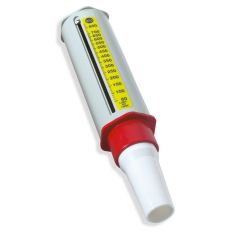
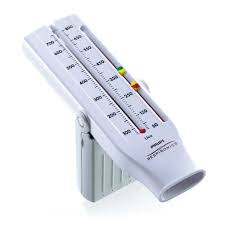
Analog Peak Flow Meters
- Simple plastic devices with a sliding indicator.
- Have the patient perform three forceful coughs or exhalations.
- Average the values to determine their PEF.
Digital Peak Flow Meters
- More accurate and easier to read.
- Some provide flow rate graphs and additional data.
- Cost more, but may be worth it for frequent use.
💡 Don’t forget to use disposable mouthpieces and disinfect the device between patients or preferably have a different device for each patient.
Where to Get One
You can find Peak Flow meters on:
- Amazon
- Medical supply websites
- Local pharmacy (some may even carry the digital models)
Final Thoughts
Peak Flow isn’t just for asthma anymore. It’s a quick, reliable, and research-backed method to help identify patients who may be at risk for penetration and aspiration. Adding this tool to your clinical swallow evaluation brings you a step closer to data-driven dysphagia management and may help you get the instrumental assessment your patient needs.
Are you ready for a deeper dive with even more resources available? Join the Dysphagia Skills Accelerator today. You will get so many great tools with new tools being added all the time! Click here to join now!
Have you ever wanted a way to create a more standardized protocol for your Clinical Swallow Evaluation? Do you often forget or leave out parts of the CSE, you know, the parts that are important for your Plan of Care? You probably need the Clinical Dysphagia Assessment Toolkit if you answered yes. You can get your copy here.
References
Gregory, S. A. (2007). Evaluation and management of respiratory muscle dysfunction in ALS. NeuroRehabilitation, 22(6), 435–443.
Hammond, C. A. S., Goldstein, L. B., Horner, R. D., Ying, J., Gray, L., Gonzalez-Rothi, L., & Bolser, D. C. (2009). Predicting aspiration in patients with ischemic stroke: Comparison of clinical signs and aerodynamic measures of voluntary cough. Chest, 135(3), 769–777.
Pitts, T., Troche, M., Mann, G., Rosenbek, J., Okun, M. S., & Sapienza, C. (2010). Using voluntary cough to detect penetration and aspiration during oropharyngeal swallowing in patients with Parkinson disease. Chest, 138(6), 1426–1431.
Plowman, E. K., Watts, S. A., Robison, R., Tabor, L., Dion, C., Gaziano, J., … & Gooch, C. (2016). Voluntary cough airflow differentiates safe versus unsafe swallowing in amyotrophic lateral sclerosis. Dysphagia, 31(3), 383–390.
Suárez, A. A., Pessolano, F. A., Monteiro, S. G., Ferreyra, G., Capria, M. E., Mesa, L., … & De Vito, E. L. (2002). Peak flow and peak cough flow in the evaluation of expiratory muscle weakness and bulbar impairment in patients with neuromuscular disease. American Journal of Physical Medicine & Rehabilitation, 81(7), 506–511.
Peak Flow meters can be purchased to use.


 Dysphagia Ramblings
Leave a comment